
For a small garden, a water feature has to earn its space. If you are looking at a tiny patio, balcony or narrow border and thinking “I’d like water, but not daily scrubbing and pump-fiddling”, you are not alone.
The key is to choose simple, self-contained features that do not need constant topping up, scrubbing or fishing out fallen leaves. If the saucer under your pots is always dry by evening, you will want something that copes well with a sunny, drying spot too.
Low-maintenance water feature ideas that work in small spaces
These ideas suit compact UK gardens, courtyards and balconies, and are chosen for easy care rather than drama:
- Self-contained solar fountains in a pot
A large frost-proof pot, a small solar pump and some pebbles can give you a gentle burble without wiring. Keep the water level above the pump and lift out the pump once a month to wipe away algae. Pick a bright, not shaded, corner or the fountain will splutter on and off.
- Still water bowl with marginal plants
A glazed bowl or half-barrel filled with water and a couple of potted marginals (such as dwarf iris, marsh marigold or small sedge) is very low effort. Top up with rainwater when levels drop. If you lift the bowl and it feels surprisingly heavy, you’re doing fine – it means it’s holding water and not leaking away.
- Wall-mounted spout into a small trough
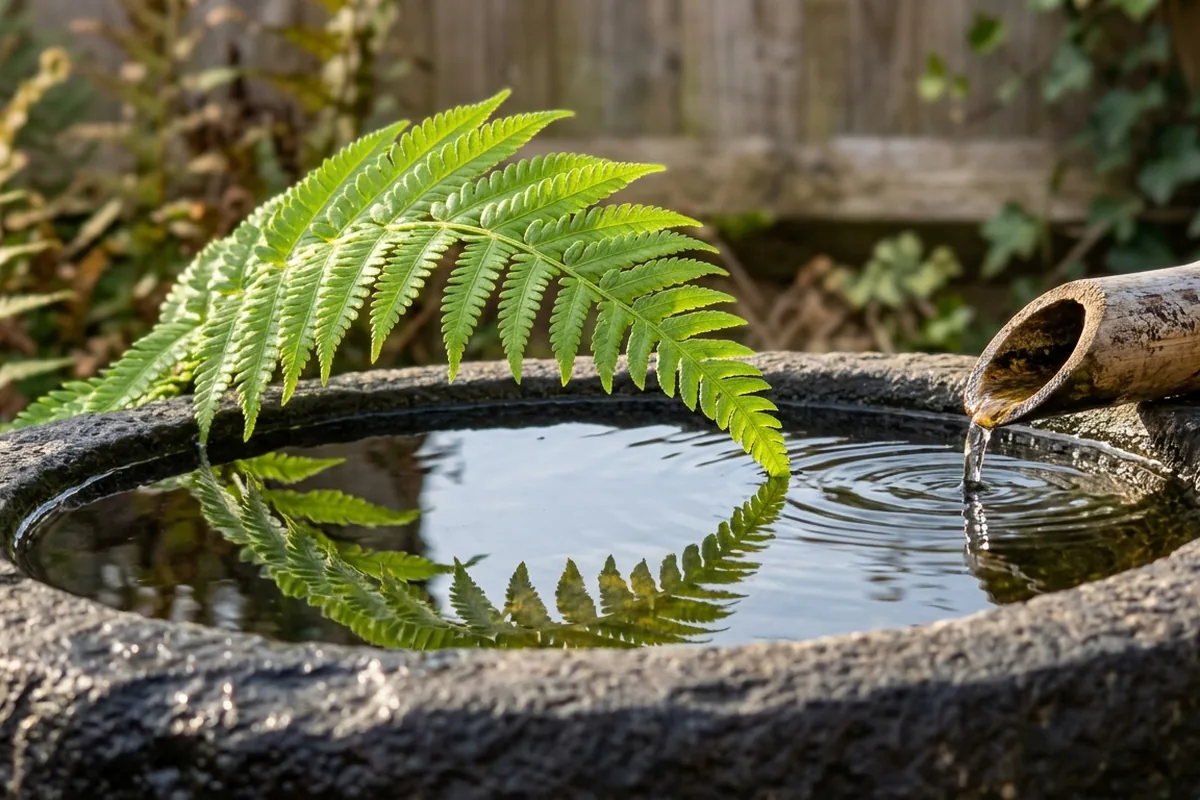
Ideal if floor space is tight. A simple spout trickling into a narrow trough or tank gives sound without needing a big pool. Go for a hidden pump with easy access – you want to reach it without dismantling half the feature. A plug-in pump on an outdoor socket is usually more reliable than solar in a shady UK yard.
- Pebble pool over a hidden reservoir
Water disappears through decorative pebbles into a buried reservoir. No open pool means fewer leaves, less algae and safer around children. You mainly need to top up water and clear the pump filter every few weeks.
How to keep it genuinely low maintenance
A water feature becomes hard work when it turns green, smells, or keeps running dry. To avoid that:
- Choose the right size. A slightly larger bowl or tank holds temperature and water level more steadily than a tiny one, so you are not out there topping up every hot afternoon.
- Site it sensibly. Full, strong sun encourages algae; deep shade collects slime and fallen debris. A bright, lightly shaded corner often gives the best balance.
- Use rainwater if you can. Tap water is fine, but hard water areas can leave limescale on dark features. A small water butt by a shed or downpipe makes topping up easier.
- Plan for leaf fall. If you’re close to a tree, choose a covered pebble pool or a narrow run of water rather than a wide open mirror that fills with leaves every autumn.
Simple care rhythm through the year
You do not need a complicated routine. A light, regular check keeps things pleasant:
- Weekly in warm weather:
Check the water level, especially after a dry, windy spell. If the pump starts gurgling or spraying wildly, it is usually pulling in air – top up straight away.
- Monthly:
Switch off the pump, lift it out and wipe the sponge filter and casing. A soft brush or old washing-up brush is enough. This is the point where many people are tempted to add chemicals; for most small features, a quick clean is all that’s needed.
- Autumn and winter:
In cold areas, either run the feature gently all winter or switch off, drain and cover to protect from frost damage, especially ceramic bowls and small plastic pumps. A simple cover or even a board over the top stops leaves and winter debris filling it.
If you start small – a single bowl or pot fountain – you will quickly see how much topping up and cleaning your space and climate demand. Once that feels easy, you can always add a second, but you do not have to turn the whole garden into a pond to enjoy the sound of water.
Reader note
The Flower Expert is an independent gardening publication. Your support helps us keep creating practical plant care guides for everyday UK readers.
This article was created with the assistance of AI and reviewed by an editor. It is intended as general gardening information, not personalised professional advice.
If you still have a question, or if something looks unclear or inaccurate, you can contact us through our contact form.
If you found this article helpful, please consider sharing it on social media or leaving a comment below with your own experience. It helps other readers too.